
The Churches of Saint Baruc, Barry Island
St Baruc is an important Celtic saint of Wales. He was a student of the famous St Cadoc and there has been a place of worship dedicated to Baruc since his burial there around the year 700 AD. The name Barry is believed to be a corruption of Baruc (and/or related to the local noble de Barri family) and during the middle ages a pilgrimage to Baruc’s burial place was considered to be very important. In fact 4 visits to Baruc were equal to 1 visit to Rome on the pilgrimage “league tables”. Thus, Barry Island became a very sacred Christian site.
The ruins of the ancient chapel and priest’s house are still used for a Celtic service on the feast of St Baruc on 27 September each year. The ruins are at coordinates 51.39221998766984, -3.267177158084634 (what3words: ///camp.people.swung; Plus Code: 9C3R9PRM+W3H)
Anglicans apparently first returned to the Island in 1881, when a mission church of St Baruc was opened at the corner of Phyllis Street and Archer Road: this may have been originally built in 1880 as Bethany English Baptist Church (https://coflein.gov.uk/en/site/9182). At the time, the Island was in Sully parish.
A new mission church of St Baruch on Clive Road was opened in November 1897 (under Egerton F. Daniell, rector of Sully: https://newspapers.library.wales/view/4598380/4598388/51/). https://coflein.gov.uk/en/site/97242/
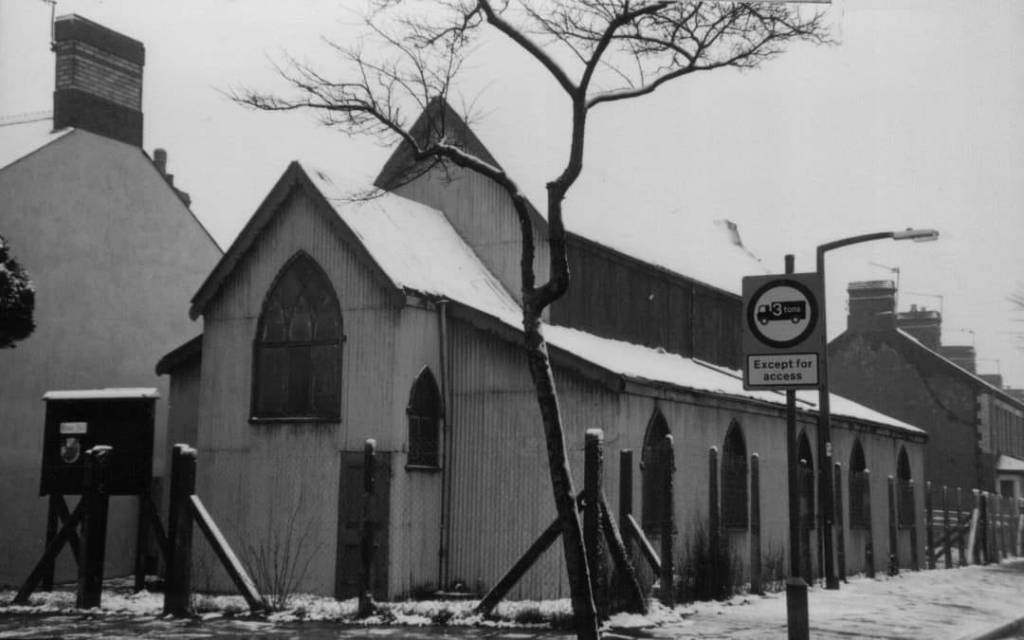
The congregation outgrew the tiny red brick church and moved to a tin chapel of St Baruc in Plymouth Road (on the corner of Archer Street), which was opened 7 August 1909 (https://newspapers.library.wales/view/4207230/4207232/55/ at this time in Sully parish: H. John Williams, rector, and Frederick William Rees, curate of Barry Island). That building was open until the 1960s.
At that point, the congregation moved back to the red brick Church of St John with St Baruc, Phyllis Street; it closed for worship after a final service on the Feast of the Epiphany, 2019.
The Parish Church of Saint Nicholas, Barry
There was a church of St Nicholas in Barry from as early as the 13th century – it is first mentioned in 1254. In a state of disrepair by the Victorian era, it was demolished in 1874, rebuilt and enlarged.
The second St Nicholas’ was consecrated 22 June 1876 and was the parish church until the early 20th century, when the even larger church of All Saints was completed. From 1910 until the Great War, it was used for Anglican services yn y Gymraeg, but All Saints’ became the parish church in 1919. Sunday School was held in the church and church hall until 1930 but St Nicholas’ was entirely disused later in the 1930s. On 9 November 1955, the building was deconsecrated in a ceremony led by the Archbishop of Wales. The Victorian building has been leased to the Sea Scouts since 1 April 1959, on the corner of Romilly Park Road and St Nicholas’ Road. ///goals.moth.merit
A church hall was first built on St Nicholas Road in 1892.
Eglwys Uchelolau and Eglwys Cwmcidy
Within the Ministry Area’s boundaries (formerly Merthyr Dyfan parish), lie the ruins of an ancient church which served a small settlement called Uchelolau. There is no surviving record of a dedication (i.e. saint’s name) for this church, if it ever had one. The church was abandoned before the Reformation and the place is now remembered in the (somewhat mistranslated) name of the Highlight Park development. ///combines.snow.intruded
Another ancient settlement, closer to Porthkerry, was called Cwmcidy. There was an ancient church here, whose district was sometimes united to Porthkerry and old Barry. If the church ever had a patron saint (dedication), it is no longer known. About half of its tiny former parish is now within our boundaries. ///fillers.nail.creatures
The Church of Saint Paul the Apostle, Barry
A daughter church of Merthyr Dyfan, St Paul’s began in a temporary building in the late 1880s before the church was built in 1892. She was consecrated on 6 September 1893 (https://newspapers.library.wales/view/4327475/4327481/104/), and a grand celebration was held on her centenary. The previous (temporary) building became the first church hall, until its demolition in 1981. For a time after the church closed in 2016, worship carried on in the church hall until 31 December 2017, when the last service was held. The church and hall have been demolished and the former site (opposite 44–68 St Paul’s Avenue) redeveloped as affordable homes. ///veal.petty.wings
Eglwys Gymreig Sant Ioan (St John’s Welsh Church)
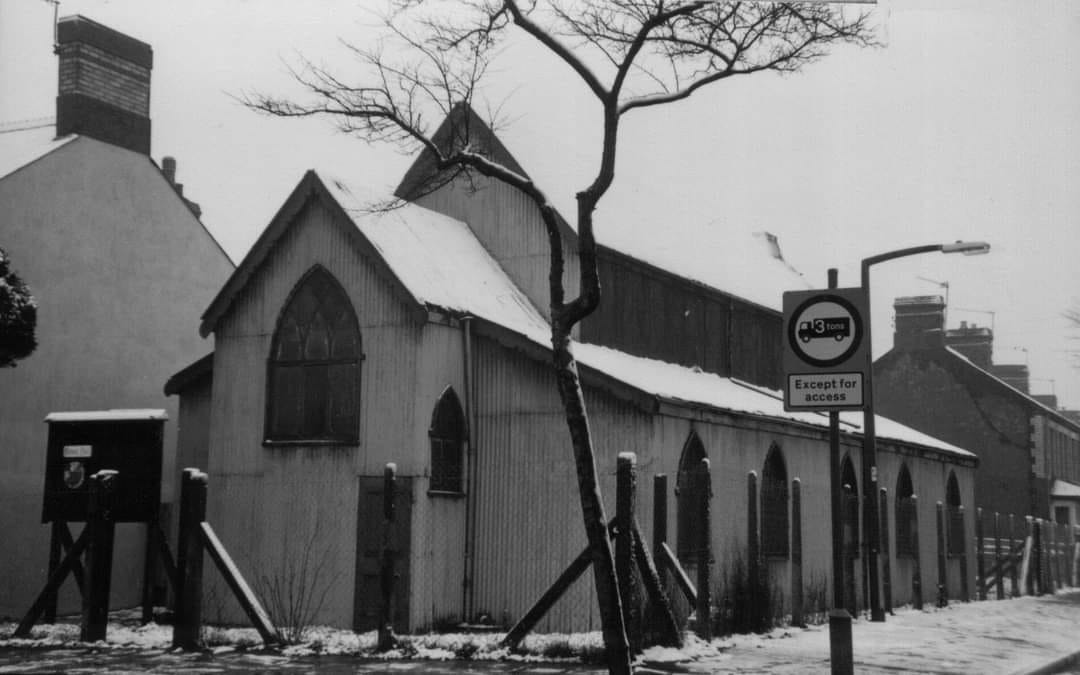
By 1889, Welsh language services were held in the Mission Room on Iddlesleigh Street. The congregation later used the Royal Hotel Cadoxton (now a Tesco Express) and the Memorial Hospital, Holton Road. A Tabernacle chapel from Penarth was relocated for Welsh-speakers in Cadoxton parish and consecrated on 13 February 1896. It was an iron building on the corner of Court Road and Wyndham Street (opposite St Helen’s Roman Catholic church). When St John’s closed in 1951, its altar and reredos were moved to St Cadoc’s. The last Anglican service in that building was held on 10 June 1951; afterwards, services yn y Gymraeg continued at St Mary’s for a little while.
A newspaper report of the consecration, with sketch, is available here: https://newspapers.library.wales/view/4597528/4597533/23
The Church of Saint Aidan, Cadoxton-juxta-Barry
Though there were earlier temporary mission churches of St Aidan, Barry library holds a photograph of St Aidan’s, Main Street, circa 1910. Converted from the town’s first permanent theatre (the Theatre Royal and Palace of Varieties, Iddlesleigh Street), the first recorded service was held on Holy Monday 5 April 1909 and the church-hall was ceremonially opened on the Feast of the Purification (Candlemas) 1910. It was closed in 1964 (the last meeting there may have been 24 June) and sold a few years later. The building having been demolished, she is remembered in the name of nearby St Aidan’s Rise.
Seamen’s Priory
The Order of St Paul the Apostle was an order of Anglican monks formed in India to aid seamen, and set up their headquarters in Barry, initially on Station Street (then in Cadoxton parish). By 1894, the monks were based at Broad Street (then in Merthyr Dyfan parish) and the site included a tin-roofed chapel on the corner of East Street. The brothers left Barry in 1912 but the chapel stood until 2019. Their successors are the brothers of Alton Abbey, whose then-Abbot Dom Giles preached at St Paul’s centenary service in 1993.
Mission halls
The first temporary church for the east side of Cadoxton was on Iddesleigh Street (now the part of Main Street between Quarella Street and Vere Street); it was licensed by the bishop for worship on 26 August 1887 and replaced by St Aidan’s. It was sometimes called the English Mission Church (contra the Welsh Mission, predecessor of yr Eglwys Sant Ioan).
The first in the west end of Cadoxton (Barry Dock), on Thompson Street, opened in November 1891 (initially Fr Usher was curate-in-charge); it was replaced by St Mary’s Hall. Then called the Barry Dock Church Room, the cornerstone was laid by Mrs Jenner on 2 May 1890, it was licensed on 28 July 1892 and used until St Mary’s Church opened in 1905. St Mary’s Hall, next to the church, served the local community as a church hall for many years until it was sold — it is now a gym. ///sport.caves.bucket
On 24 July 1897, a mission room on Park Crescent was licensed for worship by the Bishop. Services had previously been held in a room at the Park Hotel.
The Seamen’s Mission on the corner of Dock View Road and Castleland Street (Barry Dock) opened in 1905 and had a chapel of St Peter. On its closure, the bell and lectern were moved to St Mary’s. The former mission is now the Old Seamen’s Mission hotel. (Chaplains included: H.E.H. Coombes until 1907; W.P. Hosford, assistant until 1907, chaplain thereafter.)
St Michael’s mission hall was on Lombard Street, in Merthyr Dyfan parish, from before 1966 ’til after 1970.
 Barry Church in Wales